

Why Volkswagen may be facing an existential threat while it tries to negotiate its ‘ungovernable’ leadership structure

Article content
The social responsibility of business is to Increase its profits.
Milton Friedman, Nobel Memorial Prize winner in Economic Sciences
Market distortion has always been a difficult dictum to preach. Not only is it a terribly complicated theorem to wrap one’s head around, but the economy-debilitating slippery slope it projects has such a long timeline that most people, frankly, get bored at its mere mention. Even the poet laureate of capitalism, Milton Friedman, was never able to fashion any argument sufficiently compelling that economists — let alone ordinary citizens — paid attention.
Advertisement 2
Article content
The reason is simple. We, the people, have no interest in any subject financial beyond our next pay-cheque. And the very few of us who profess having a long-term view are more likely thinking about next year, or, if we’re trying to claim we’re especially forward-thinking, the year after that. A theory that proclaims problems a decade or two down the line has simply no hope of gaining traction with anyone, lest they are determined to be the person most avoided at dinner parties. The only reason I’m bring this up now — and risking that same rejection — is that, if the deluge of news emanating from Volkswagen these days is any indication, that decade or two has finally caught up with Europe’s largest automaker.
In case you haven’t read Reuters’ Auto File lately, let me recap: Volkswagen AG is looking at some serious financial travails. Oh, to be sure, the company often finds itself in such deep waters, the US$33.3 billion and counting it blew on the Dieselgate scandal just one of the many difficulties that seem part and parcel of being Germany’s most prolific automaker.
Advertisement 3
Article content
Recommended from Editorial
-

Motor Mouth: Why Canadian tariffs on Chinese EV are absolutely necessary
-

Motor Mouth: EV mandates are under threat
But this one is starting to sound existential. If Reuters has its facts straight, the company’s bottom line is so stretched that it wants to, for the first time in its modern history, shut down some hometown manufacturing plants. Sales are down, profits bleak, and, most debilitating of all, the electric-vehicle revolution the company completely bought into is slowing down. It needs to make changes.
Only it can’t.
This, unfortunately for those bored with any discussion of corporate finances, is where we get into Milton’s famed market distortions. The first problem is that Volkswagen’s management are not master of their own domain. Not only does the local Lower Saxony government in Germany have a 20% voting share of the company’s stock — and all the interference that government ownership brings — but labour representatives hold half the seats on the company’s board.
Advertisement 4
Article content
Worse yet, by law, a two-thirds majority is needed for the “construction and relocation of production facilities,” which means that such large decisions can’t be made without union approval. Or as Ferdinand Dudenhoeffer, head of the CAR think tank at the University of Duisburg-Essen, told Reuters, the leadership structure is “paralysing VW, making it ‘ungovernable.’”
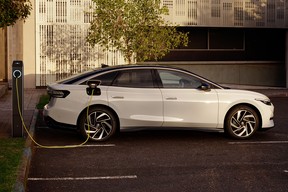
Nor are these the only manacles hamstringing VW’s management. The growth of the EV segment is slowing down, sufficiently so that it is making the company’s humongous commitment to EVs — USD$131 billion and counting — seem rash. Automakers need to plan production years in advance. A few years ago, the E.U.’s impending EV mandate and the rapid growth of battery-powered vehicle sales led to VW betting big on a ZEV future. Today’s slowdown in EV sales growth, largely based on their high cost, is making those investments look premature.
Advertisement 5
Article content
Nor can Volkswagen simply import desirable low-cost EVs from its plants in China because, well, as we’ve all heard, the European Union has imposed tariffs on everything EV. Yes, even those wearing domestic badging. In fact, Volkswagen told Reuters that it won’t be able to afford to import the Chinese-built Tavascan as a result of the E.U.’s 21.3% tariff, and so its Cupra subsidiary could face fines for not meeting greenhouse-gas-reduction targets.
More important even than the consequences of forcing a technology on automakers is the fact that overall sales across the E.U. are down. What was once a 16-million-vehicle-a-year market before the pandemic has now become a much more sobering 13 million. Indeed, one of the dirty little secrets of the automotive statistics being bandied about is that while EVs sales are kinda holding steady at 15% of the market across the E.U. — and eking out small increases in a few countries — the total number of cars being sold is down. Sufficiently so that it seems Volkswagen really does need to close plants. And where better to do so than in labour-expensive Germany? Except for, well, unions.
Advertisement 6
Article content
Current conflicting influences — EV mandates versus tariffs, the need for cheaper EVs versus higher wages, etc. — aren’t going to get us to the emissions-free, ESG-influenced nirvana promised
As bleak as Volkswagen’s plight might be, it is not alone. North American automakers might not be nearly as constricted as their European brethren — Renault, for one, is worried it may face a USD$17.4-billion fine because consumers are not buying enough EVs to meet the company’s CO2-reduction targets — but they are not without conflicts. No sooner, for instance, had the American government announced it would subsidize battery manufacturing in the United States than an invigorated UAW took back a sizable chunk of the government’s largess with huge wage demands.
Now, one can commiserate all you want with auto-workers, but it doesn’t change the fact a significant portion of the monies meant to make domestic automakers more competitive with Chinese interlopers ended up elsewhere.
Advertisement 7
Article content
Nor are all the monies offered by the Inflation Reduction Act finding welcome homes. Despite the many incentives it proffers, an increasing number of battery makers are declining its generosity. Indeed, Steve Levine at The Electric recently opined that “one in four recipients of a U.S. battery grant has given them up.” Current conditions — weak U.S. sales and a significant drop in lithium pricing — are not conducive to the risk of building new plants in high-cost America.
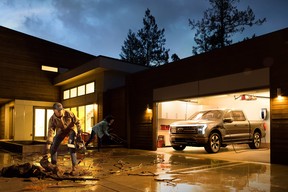
But what about those who have already ramped up EV production? The list of automakers backing away from previous electric-vehicle promises is long. In North America, General Motors and Ford have both rescinded predictions of future ICE-free production. Foreign automakers including Mercedes-Benz and Audi are likewise backtracking.
Advertisement 8
Article content
What happens, though, when American fuel-economy standards — which, according to experts, act like de facto EV mandates — force them to sell cars that American consumers are plainly saying they don’t want? It may not be the kind of noose that is strangling Volkswagen, but anyone thinking there won’t be adverse consequences to this conundrum really doesn’t appreciate the force of market economics.
That’s not to say automakers should be free from regulation. Unfortunately, history is replete with the ineptitude, obstruction, and outright malfeasance made in the name of profitable automaking. We have strict regulation regarding safety, for example, because of exploding Ford Pintos. American manufacturers must abide by those aforementioned onerous fuel-economy standards — and ours, an EV mandate — because auto giants back-pedalled, cheated, and manipulated every previous attempt at regulating tailpipe emissions. Some, including this Motor Mouth, might lament the rules currently stifling some parts of the industry, but it’s not like automakers didn’t deserve the comeuppance.
Advertisement 9
Article content

Nonetheless, current conflicting influences — EV mandates versus tariffs, the need for cheaper EVs versus higher wages, etc. — aren’t going to get us to the emissions-free, ESG-influenced nirvana promised. There isn’t, for instance, much use in allowing environmental activists to dictate EV mandates if spotted owl conservationists are going to prevent the mining of lithium. Some kind of cohesive plan is needed, one that includes guidelines for safety and emissions, but likewise delineates how the conflicts these regulations engender would be resolved.
What takes priority? The economy or the environment? Low-cost EVs or the wages of those producing them? Volkswagen’s dilemma would seem a perfect example of what happens when there is no script for how to resolve seemingly intractable conflicts.
Advertisement 10
Article content
What we’re left with otherwise is a mess. Indeed, considering its multiple masters, Volkswagen now seems like little more than a branch of the German government. And, while there’s no doubt many that would applaud such a transformation — all those who worship at the altar of ESG, DEI, and everything environmental are no doubt applauding the very restrictions I’m lamenting — let’s understand that the inevitable result is a company that is now as efficient as government.
Maybe we should have been paying more attention to what Milton was preaching so long ago.
Sign up for our newsletter Blind-Spot Monitor and follow our social channels on X, Tiktok and LinkedIn to stay up to date on the latest automotive news, reviews, car culture, and vehicle shopping advice.

David Booth
David Booth is Driving’s senior writer as well as the producer of Driving.ca’s Driving into the Future panels and Motor Mouth podcasts. Having written about everything from the exact benefits of Diamond Like Coating (DLC) on motorcycle camshafts to why Range Rovers are the best vehicles for those suffering from opiod-induced constipation, Booth leaves no stone unturned in his quest for automotive veritas. Besides his long tenure with Driving, he was the editor in chief of Autovision magazine for 25 years and his stories has been published in motorcycle magazines around the world including the United States, England, Germany and Australia.
Education
Graduating from Queen Elizabeth High School in 1973, Booth moved to from his Northern Quebec home town of Sept-Iles — also home to Montreal Canadiens great, Guy Carbonneau, by the way — to Ottawa to study Mechanical Engineering at Carleton University where he wrote a thesis on the then burgeoning technology of anti-lock brakes for motorcycles and spent time researching the also then burgeoning use of water tunnels for aerodynamic testing.
Experience
After three years writing for Cycle Canada magazine and another three working for the then oldest magazine in Canada, Canadian Automotive Trade, Booth, along with current Driving writer, Brian Harper, and then Toronto Star contributor, Alex Law, created an automotive editorial services group that supplied road tests, news and service bulletins to what was then called Southam newspapers. When Southam became Postmedia with its purchase by Conrad Black and the subsequent introduction of the National Post, Booth was asked to start up the then Driver’s Edge section which became, as you might suspect, Driving.ca when Postmedia finally moved into the digital age. In the past 41 tears, Booth has tested well over 500 motorcycles, 1,500 passenger cars and pretty much every significant supercar of the last 30 years. His passion — and, by far, his proudest achievement — however is Motor Mouth, his weekly column that, after some 30 years, remains as incisive and opinionated as ever.
Personal
Booth remains an avid sports enthusiast — that should be read fitness freak — whose favourite activities include punching boxing bags until his hands bleed and running ski hills with as little respect for medial meniscus as 65-year-old knees can bear. His underlying passion, however, remains, after all these years, motorcycles. If he’s not in his garage tinkering with his prized 1983 CB1100RC — or resurrecting another one – he’s riding Italy’s famed Stelvio Pass with his beloved — and much-modified — Suzuki V-strom 1000. Booth has been known to accept the occasional mojito from strangers and the apples of his eye are a certain fellow Driving contributor and his son, Matthew, who is Global Vice-President of something but he’s never quite sure what. He welcomes feedback, criticism and suggestions at [email protected]

link