


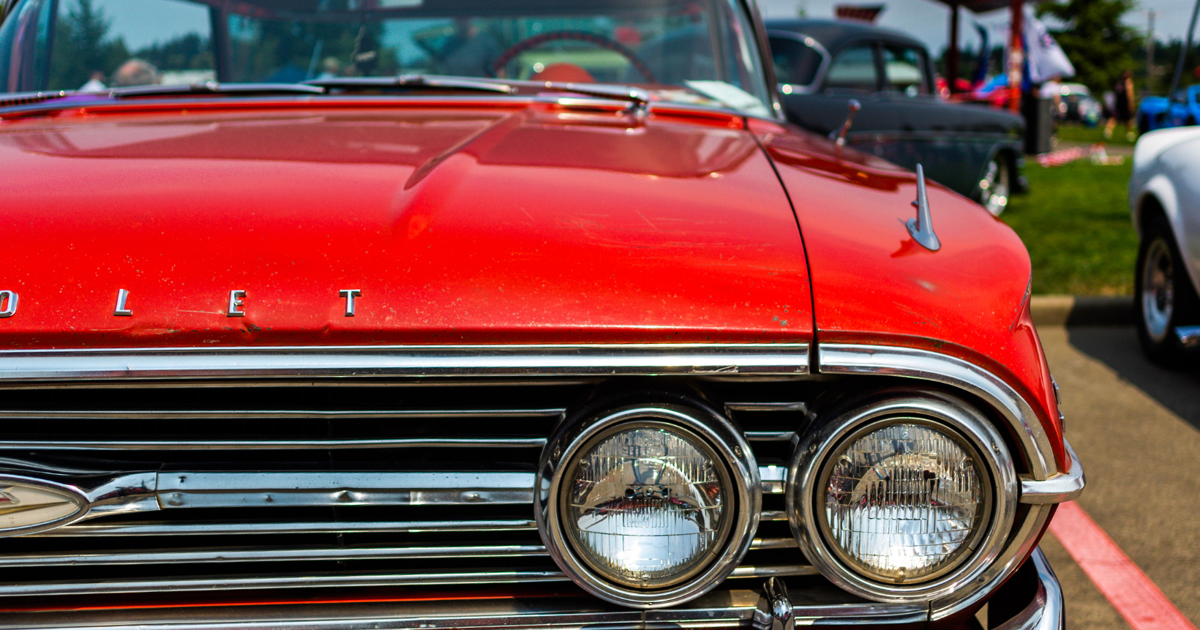
Auto pioneers, union leaders, designers, and philanthropists — Jewish Detroiters have long fueled the heart of Michigan’s auto industry.


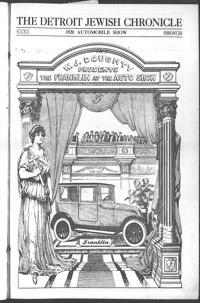
For the last 100 years, Detroit has been known as the Motor City. It earned this title because, for many decades, it led the world in automobile production. Although it no longer makes as many vehicles as it used to, Detroit and Michigan still produce more cars and trucks than any other state, 20% of U.S. production.
Likewise, 20% of Michigan’s workforce, more than 1 million jobs, are auto related, and their work contributes more than $300 billion to the state’s economy. The key term is “auto related.” While more than 200,000 people are employed at major car makers in Michigan — Ford, GM and Stellantis — hundreds of thousands of other workers are employed at auto parts suppliers, design firms, car dealerships and advertising firms, or hold positions as auto-related data analysts, designers, architects and engineers.
In short, automobile manufacturing is exceedingly complex. Whatever car or truck you drive, it has about 15,000 individual parts. Moreover, modern vehicles contain an increasing number of computer chips, video screens and other digital hardware. The supply chains for these components now stretch around the world.


“Auto related” work goes well beyond the making of cars and parts. Once a vehicle is purchased, gas stations are a necessity, and increasingly, electric charging stations. Add in motels, drive-in windows at McDonalds and scenic sites for road trips. And all these events, as well as the industry itself, are reported on by automotive writers.
Jewish Detroiters have made significant contributions to Detroit’s well-deserved stature as the world’s Motor City. For the past 130 years, Jews have worked in the many occupations that comprise the overall industry and car culture. Here are just a few stories among thousands about Jews and cars.
Pioneering Automotive Maker
The first notable Jewish automobile builder, one of America’s first makers of trucks for commerce, was Detroiter Max Grabowsky (1874-1946). He founded the Grabowsky Motor Vehicle Co. in 1900, and with his brother, Morris, designed a commercial vehicle that is believed to be the first truck in Detroit. The company sold its first truck in 1902 and reorganized as the Rapid Motor Vehicle Company (1902-1908), with Grabowsky as president.

His trucks developed a reputation for durability and power.General Motors, formed in 1908, bought the Rapid Motor Vehicle Company in 1909 and began selling trucks under the GMC brand. Grabowsky then worked as president and founder of the Grabowski Power Wagon Co., 1908-1912. He was also a manufacturing leader in WWI, coordinating airplane and parts production.
Rising to the Top — Jewish Auto Executives
In 1913-14, after Henry Ford introduced the moving assembly line at his Highland Park plant — this factory produced 25% of the world’s cars at the time — Ford Motor Company needed thousands of unskilled workers. Ford then raised wages to an unheard of $5 a day in 1914. Other car companies soon followed suit. These jobs were perfect for millions of unskilled immigrants moving to America, including Jews from Eastern Europe
However, only a few Jews reached top administrative positions in the early years of the industry. Meyer Prentis (1886-1970) was one of them.
Born in Lithuania, Meyer Leon (Prensky) Prentis immigrated to America as a child. He took a job as an accountant at General Motors in 1911. After promotions to various positions, Prentis was named the company’s treasurer in 1919 and held that position for 32 years.


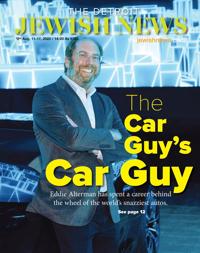
Prentis retired in 1951, after laying the foundation for other Jewish executives. Just to name two: Gerald Meyers (1928-2023) and Mark Fields (b. 1961). Both held the top position at the two largest American car makers.
Meyers was born in Buffalo, the son of a tailor and opera singer. After working at Ford and Chrysler, he was named chairman and CEO of American Motors Corp (AMC) in 1977. Only 49 years old, Meyers was the youngest top executive in the American auto industry. He retired in 1982.
Born and raised in NYC, Mark Fields was hired by Ford and, at 39, ran the company’s Argentine operations. After managing various departments at Ford, he was named president and CEO of Ford in 2014. Fields retired in 2017.
The King of Auto Factory Design
Albert Kahn (1869-1942) was a Jewish Detroiter who became the most famous designer of automotive factories in American history. He was a self-taught architect, who revolutionized the process of industrial design by incorporating architects and engineers into a single firm, Albert Kahn Associates. It is still in operation today.
His brother, Julius, was a key partner. He invented a successful method of using reinforced concrete for construction of modern, fire-proof buildings and factories.
The list of Kahn-designed auto factories is massive. The first was for Packard in 1903. Just a few of his early designs and builds include the Grabowsky Power Wagon Factory, Detroit (1907); the Hudson Motor Car Co., Detroit (1910); and the Dodge Brothers Co. “Dodge Main” plant in Hamtramck (1911).
Kahn’s most famous factories were Ford’s Highland Park plant, “The Crystal Palace” in (1910) and its River Rouge Complex in Dearborn (1917-1928). For many years, the “Rouge” was the largest industrial facility in the world. All of Kahn’s car factories had his trademark designs — lots of windows and skylights.
Kahn also designed other non-
automotive buildings such as the massive GM office building (1922); the Fisher Building (1928), Detroit’s largest art deco masterpiece; the second and third Temple Beth Els in Detroit; and with George Mason, Detroit’s Belle Isle Aquarium.
Supplying the Auto Industry
To make a finished vehicle, a factory needs parts. Lots and lots of parts. From the beginning of auto manufacturing, the car companies have relied on automotive suppliers.
The Dodge Brothers, for example, became two of the world’s wealthiest people by supplying Henry Ford with engines and drivetrains for his famous “Model T,” before deciding to manufacture their own cars in 1914.


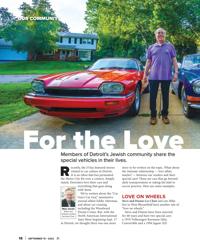
One of the most successful auto suppliers in American history was Jewish Detroiter William “Bill” Davidson (1922-2009). An innovative entrepreneur and superb businessman, he developed Guardian Industries into one of the world’s leading producers of automotive glass, among other glass products for construction.
Davidson became one of the richest people on the planet, and one of America’s leading philanthropists, supporting many organizations and projects for Jews in Detroit and America, as well as in Israel.
Automotive Labor — the UAW
Although the United Automobile Workers of America (UAW) can no longer boast of having 1.5 million members as it did in 1978, the UAW is still the most powerful, influential labor union in the automotive industry. And it was a union shaped by its Jewish members.
The UAW was established during the Great Depression of the 1930s, the worst economic crisis in global history. At its depths, more than 25% of the American workforce was unemployed, including hundreds of thousands of auto workers.

The UAW was founded during this era in 1935, to give the masses of auto factory workers a voice in negotiations with car companies. It was a union that Jews helped build and lead.
For example, take Irving “Irv” Bluestone. Born in New York in 1917, Bluestone earned a degree from City College of New York. While studying in Europe, he experienced firsthand the Nazi “Anschluss “in Austria in 1938. Bluestone decided that the Labor movement was the “best antidote to fascism.”
Bluestone joined the UAW in 1942 and soon came to the attention of legendary UAW President Walter Reuther, who brought him to Detroit in 1947. After working closely with Reuther, he was appointed director of the UAW’s GM Department in 1970 and elected a UAW vice president in 1972. Bluestone retired from the UAW in 1980, universally recognized as a keen mind, a “Labor Intellectual,” and revered for his decency and humanity.
Another Jewish UAW leader was Nat Weinberg, the union’s top researcher for many years. He joined the UAW in 1947 and was named the union’s
director of special projects and economic analysis in 1957, a position he held until he retired in 1974. Weinberg was a great researcher and a very tough negotiator. It was said that if you gave him “a few hours, cigarettes and a pot of coffee, he would figure a way to split a penny five ways.” In addition, Weinberg often worked as an economic consultant to the United Nations.
Selling Cars and Trucks
Once finished, a car or truck must be marketed and sold. The primary liaison between the car makers and individual consumers is the dealer. Jews have owned car dealerships in Detroit since the early years of the industry.
One of the first Jewish-owned dealership chains was the Aaron DeRoy Motor Car Co. It was the featured dealer for Hudson-Essex and Studebaker cars.
Well-known Jewish car dealers in Metro Detroit today include Tamaroff, Glassman and Feldman. The Tamaroff Auto Group was founded by Marvin Tamaroff in 1969. That same year, Jerome Glassman opened an Oldsmobile dealership, the forerunner of today’s Glassman Automotive Group.
The Feldman Automotive Group also operates auto dealerships. Marty Feldman opened James-Martin Chevrolet in Detroit in 1973 and then started a dealership under his own name in Novi, Michigan, in 1981. Daughter, Marla, and son, Jay, now lead the company.
Fueling Your Car
Once you have bought your vehicle of choice, then, you need to fuel it (or charge it, if an electric model!). One of the most prominent Jewish Detroiters in history made his bones providing petroleum products for your car. Max Fisher, the son of Russian Jewish immigrants, attended Ohio State University, and after graduation in 1930, joined his father’s motor oil reclamation business, Keystone Oil Refining Company.
Fisher formed his own company, Aurora Gasoline, in 1932, and grew it into one of the largest gas station chains in the Midwest. Fisher sold his business to Marathon Petroleum in 1959. Fisher, like Bill Davidson, also became one of Detroit’s most prominent philanthropists and an important powerbroker in Detroit, in national politics and in Israel.
One of the most direct auto
connections to the community are independent Jewish-owned gas stations. For one example, beginning in 1952, Polish immigrant brothers, Zygie and Sol Allweiss — both Holocaust survivors — owned several local gas stations: Sol & Zygie’s Standard Oil station on Dexter near Davison, on McNichols near the University of Detroit, and later, the Mobil Station at 10 Mile and Greenfield in Southfield. They were also among the first stations to employ women gas pump attendants.
Today, the Marathon station on Franklin Road in Franklin is owned by a Jewish brother-and-sister team: Darrell Marx and Pam (Marx) Migliore. Their late father, Irving Marx, opened a Standard station at 11 Mile and Greenfield in 1953, and later owned the Total station at 12 Mile and Southfield roads, and two Shell stations on 12 Mile Road.
Writing about Car Culture
Of course, how do we know all of the above? Because somebody becomes an automotive writer or historian.
The Motor City has many auto writers, and since 1925, has been the home of the world’s authoritative industry journal, Automotive News.
One prominent auto writer is Jewish Detroiter Eddie Alterman. Born and raised in Huntington Woods, he attended the University of Michigan. While there, Alterman went to the offices of Automobile, a leading journal at the time, and began his career as a “motor gopher” (car washer and gasser-upper). He also delivered exotic cars to test drivers.
Alterman turned his love of cars and degree in English from U-M into a career. In 2009, he was named editor-in-chief of Hearst Magazine’s Car & Driver, the world’s largest automotive magazine.
There is one last link in the chain of auto making. Simply stated, Jewish Detroiters love cars. If you grew up in Detroit, you have likely worked in or have brothers, sisters, parents, grandparents or friends who have worked in the auto industry.
Car making in the Motor City is often a family affair, and Jewish Detroiters have made their mark on car culture and the auto industry.
link