


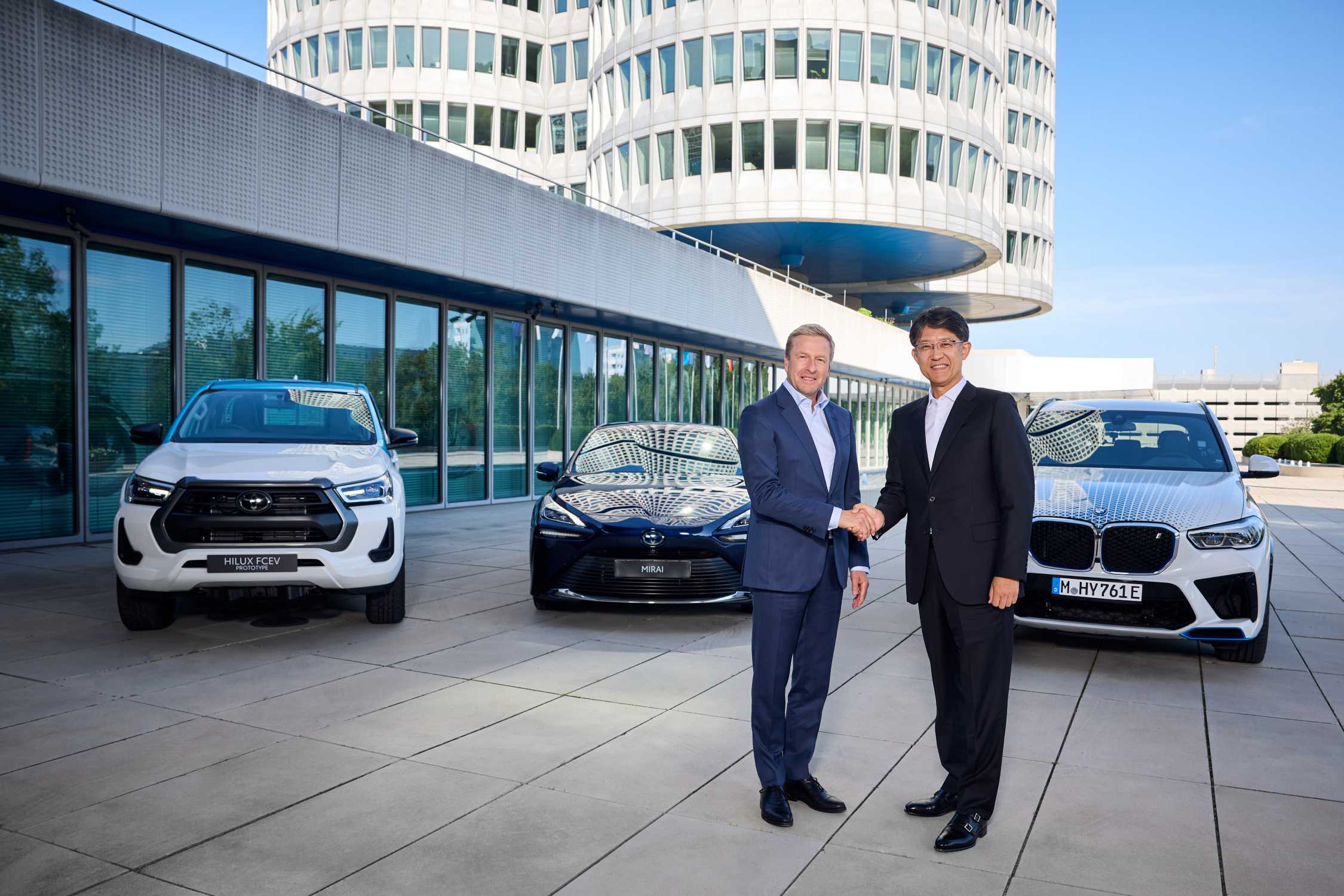
Munich. BMW plans to launch its first-ever series
production fuel cell electric vehicle (FCEV) in 2028, thereby offering
customers an additional all-electric powertrain option with zero local
emissions in a BMW. The BMW Group and the Toyota Motor Corporation are
pooling their innovative strength and their technological capabilities
to bring a new generation of fuel cell powertrain technology to the
roads. Both companies share the aspiration of advancing the hydrogen
economy and have extended their collaboration to push this locally
zero-emission technology to the next level.
The BMW Group’s leading development expertise in electric drive
technologies is once again demonstrated by its relentless efforts to
advance hydrogen fuel cell technology and its embracing of a
‘technology-openness’ approach in order to provide customers with a
range of mobility solutions for the future.
“This is a milestone in automotive history: the first-ever series
production fuel cell vehicle to be offered by a global premium
manufacturer. Powered by hydrogen and driven by the spirit of our
cooperation, it will underscore how technological progress is shaping
future mobility,” said Oliver Zipse, Chairman of the Board of
Management of BMW AG. “And it will herald an era of
significant demand for fuel cell electric vehicles.”
Koji Sato, President and Member of the Board of Management
(Representative Director) Toyota Motor Corporation, said,
“We are pleased that the collaboration between BMW and Toyota has
entered a new stage. In our long history of partnership, we have
confirmed that BMW and Toyota share the same passion for cars and
belief in ‘technology openness’ and a ‘multi-pathway’ approach to
carbon neutrality. Based on these shared values, we will deepen our
collaboration in efforts such as the joint development of
next-generation fuel cell systems and the expansion of infrastructure,
aiming for the realization of a hydrogen society. We will accelerate
our efforts together with BMW and partners across various industries
to realize a future where hydrogen energy supports society.”
Shared powertrain technology utilized across individual models
to offer attractive FCEV options.
The BMW Group and the Toyota Motor Corporation will jointly develop
the powertrain system for passenger vehicles, with the core fuel cell
technology (the individual third-generation fuel cells) creating
synergies for both commercial and passenger vehicle applications. The
result of this collaborative effort will be utilized in individual
models from both BMW and Toyota and will expand the range of FCEV
options available to customers, bringing the vision of hydrogen
mobility one step closer to reality. Customers can expect the BMW and
Toyota FCEV models to maintain their distinct brand identities and
characteristics, providing them with individual FCEV options to choose
from. Realizing synergies and amalgamating the total volume of
powertrain units by collaborating on development and procurement
promises to drive down the costs of fuel cell technology.
BMW will launch its first hydrogen-powered production model in
2028.
After successfully testing the BMW iX5 Hydrogen pilot fleet
worldwide, the BMW Group is now preparing for series production of
vehicles with hydrogen drive systems in 2028 on the basis of the
jointly developed next-generation powertrain technology. The series
production models will be integrated into BMW’s existing portfolio,
i.e. BMW will offer an existing model in an additional hydrogen fuel
cell drive system variant. As FCEV technology is another electric
vehicle technology, the BMW Group explicitly views it as complementing
the drive technology used by battery electric vehicles (BEV) and next
to plug-in hybrid electric vehicles (PHEV) and internal combustion
engines (ICE).
A new level of partnership.
The BMW Group and the Toyota Motor Corporation can look back on over
a decade of trusting and successful collaboration. Building on this,
the companies are now extending their cooperation to accelerate
innovation of next-generation fuel cell powertrain systems and pioneer
this new technology.
Shared vision of advancing the hydrogen economy.
The pathway to realizing the full potential of hydrogen mobility
includes its use in commercial vehicles and the establishment of a
refuelling infrastructure for all mobility applications, including
hydrogen-powered passenger vehicles. Recognizing the complementary
nature of these technologies, the BMW Group and the Toyota Motor
Corporation are supporting the expansion of both hydrogen refuelling
and battery electric vehicle charging infrastructure. Both companies
are encouraging sustainable hydrogen supply by creating demand,
working closely with companies that are building low-carbon hydrogen
production, distribution, and refuelling facilities.
The BMW Group and Toyota Motor Corporation are advocating the
creation of a conducive framework by governments and investors to
facilitate the early-stage penetration of hydrogen mobility and ensure
its economic viability. By promoting the corresponding infrastructure,
they aim to establish the FCEV market as an additional pillar
alongside other powertrain technologies. Furthermore, the companies
are seeking regional or local projects to further drive the
development of hydrogen infrastructure through collaborative initiatives.
Benefits of hydrogen-powered technology.
Hydrogen is recognized as a promising future energy carrier for
global decarbonization. It acts as an effective storage medium for
renewable energy sources, helping to balance supply and demand and
enabling a more stable and reliable integration of renewables into the
energy grid. Hydrogen is the missing piece for completing the electric
mobility puzzle where battery electric drive systems are not an
optimal solution.
link